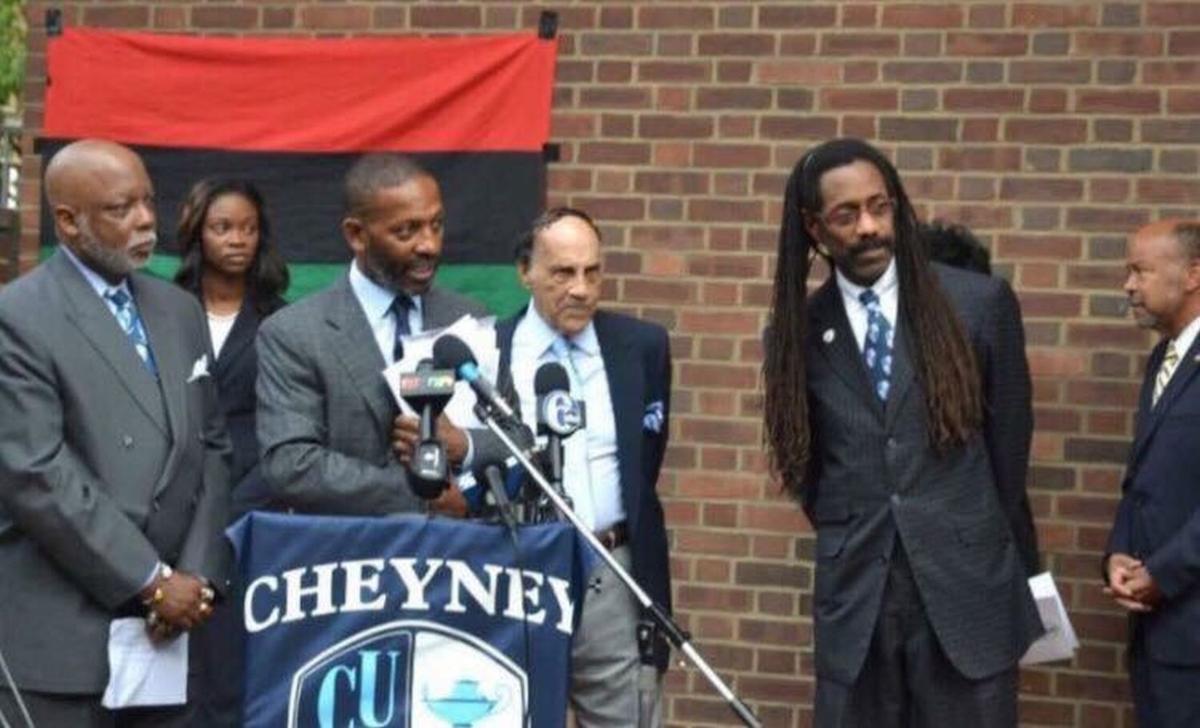
By the way, for those who think these problems are not the result of past racial discrimination by White officials in Harrisburg but instead are self-inflicted wounds by Black administrators at Cheyney, consider the following:
1969- The Commonwealth, as recently as 1969, was one of just ten states (including the usual suspects, namely Mississippi, Georgia, North Carolina, et al) determined by the U.S. Department of Education to have been blatantly discriminating against Blacks in higher education.
1983- It was not until 1983 that the Commonwealth, for the first time ever, finally submitted a formal anti-racial discrimination plan that was deemed acceptable by and to the U.S. Department of Education following repeated warranted rejections.
1999- At the insistence of the U.S. Department of Education’s Office for Civil Rights, the Commonwealth was compelled to “do the right thing” by signing a formal agreement to resolve then-unresolved issues regarding racial discrimination against Cheyney. But that agreement has been breached by the Commonwealth and, as of 2017, those issues remain unresolved. As a result of that breach, the Commonwealth, since 1999, owes Cheyney approximately $100 million.
Imagine where Cheyney would be if it had not been victimized by that documented and irrefutable racism. Despite that racism, Cheyney has produced the following:
Octavius Catto (1858) — Prominent voting/civil rights activist and educator
Martha A. Fairbeau (1859) — The school’s first female graduate and a top academic student
Rebecca Cole (1863) — One of the first two Black female medical doctors in America
Julian Abele (1896) — Preeminent architect who designed the Philadelphia Art Museum and the Free Library
Bayard Rustin (1937) — Renowned civil rights activist and adviser to Rev. Dr. Martin Luther King Jr.
Dr. Marcus Foster (1947) — Nationally distinguished educator and administrator
Ed Bradley (1964) — Nineteen-time Emmy Award and one-time Peabody Award winning 60 Minutes correspondent
Jim Vance (1964)- Nineteen-time Emmy award winning television news anchorman
Samuel J. Patterson (1982) — Multimillionaire CEO of Veridyne, Inc., an information management and technology consulting company
Andre Waters (1984) — Superstar Philadelphia Eagle
These illustrious persons are just the tip of the iceberg among the thousands of successful Cheyney graduates who have excelled despite Pennsylvania’s long history of educational (and other) racism.
In fact, Cheyney graduates and students- as attendees of the only state-owned HBCU in Pennsylvania- are a prime example of overcoming the racist odds. Such cultural and intellectual toughness is the hallmark of Cheyney and of all HBCUs notwithstanding the undeniably racist obstacles the graduates faced and the students face. This toughness explains why- despite Blacks constituting only 13 percent of this country’s population- HBCUs produce 85 percent of Black medical doctors, 80 percent of Black judges, 75 percent of Black PhDs, 75 percent of Black veterinarians, 50 percent of Black attorneys (including me!), and 50 percent of Black professors (also including me!). Where would Black America be without Black colleges?
Historic Cheyney University, founded in 1837 as the African Institute and later changed its name to the Institute for Colored Youth, is the oldest Black institution of higher learning in America. It survived slavery. It survived sharecropping. It survived Jim Crow. But because of the systemic racism endemic to America in general and Pennsylvania in particular, Cheyney might not survive the current accreditation crisis or the current Task Force cutback/demeaning crisis.
But I shouldn’t say “might not survive” these crises. Instead, I should say “will survive” these crises. That’s because Cheyney is tough. And we fight hard. And we will fight hard “by any means necessary” to save and enhance our historic alma mater. We will do so in the state capitol. We will do so in the courts. We will do so in the streets.
And fortunately, we have a friend in Governor Tom Wolf who has told us that Cheyney will not fail on his watch. In fact, Heeding Cheyney’s Call (HCC), which is the activist group leading the political, legal, and grassroots charge on the school’s behalf, recently sent him a detailed letter expressing our urgent concerns and requesting immediate and substantive action. He responded by indicating that HCC’s letter “resonated” with him and that he has assembled a team of education experts who are working to save Cheyney. We trust him. However, as a former U.S. president once said, “Trust but verify.”
HCC will seek that verification when we hold our upcoming press conference/rally outside Governor Wolf’s Philadelphia office. We invite the media, Cheyney alumni, Cheyney students, Cheyney faculty, Cheyney staff, and all Black people who love Cheyney as well as inviting the public at large to attend that press conference/rally on August 1 at 11:00 a.m. in front of the Governor’s office at 110 North Eighth Street.
About Post Author
