


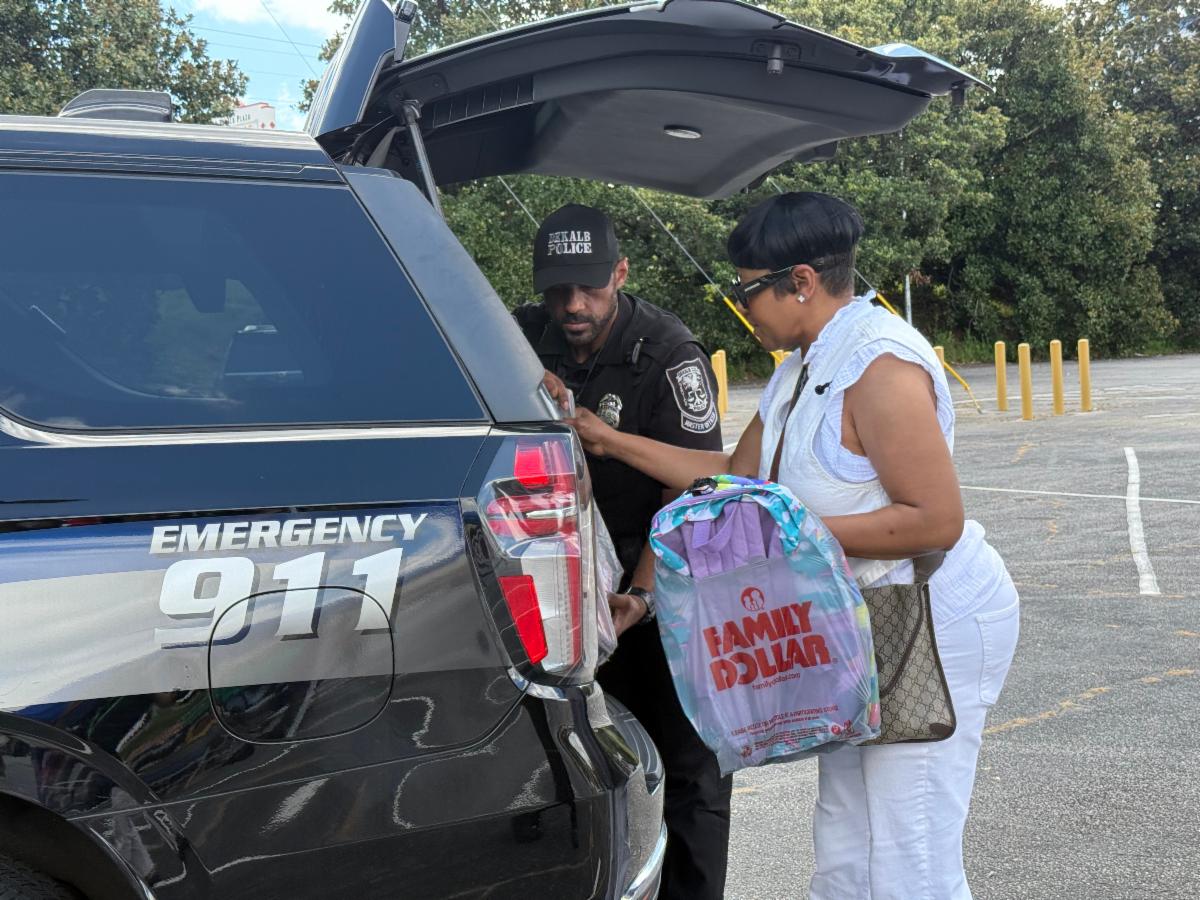
On Saturday, July 26, DeKalb County held its 5th Annual Stuff the Bus School Supply Drive, an ongoing community tradition led by CEO Lorraine Cochran-Johnson. The event took place from 10 a.m. to 1 p.m. at three donation sites: South DeKalb Mall, DeKalb County Police Headquarters – Tucker, and Dunwoody City Hall.
“This was actually my fifth annual Stuff the Bus event,” CEO Cochran-Johnson said. “I take it very personally because, when it comes to our children and making sure they’re prepared, we don’t all start at the same place.”
Residents across the county stepped up with generous donations of backpacks, notebooks, pencils, crayons, folders, glue sticks, and more. All supplies collected were donated directly to students in the DeKalb County School District through partnerships with local schools, teachers, and nonprofit organizations.
With more than 92,000 students and 13,000 educators, DeKalb County is the third-largest school district in Georgia. “Those numbers translate into a massive amount of need for our children,” said CEO Cochran-Johnson. “We gave so they could have a great start.”
Speaking from both personal and professional experience, CEO Cochran-Johnson shared that educational equity has always been a driving force behind her efforts.
“There’s a lot of inequity out there when it comes to homes and access,” she said. “And because I’ve answered the phone, not as a CEO, but as a community member, I’ve seen children who simply don’t have the resources they need.”
CEO Cochran-Johnson stressed the importance of collective responsibility, highlighting that every student deserves the opportunity to succeed.
“Regardless of your socioeconomic background, I truly believe the words of Nelson Mandela: education is the most powerful weapon we can use to change the world,” she said. “I came from humble folks who valued education, who saw it as a tool of progression. Because no matter where you go, people can’t take away what you know.”
This year’s Stuff the Bus drive continued to build on that vision, removing barriers to learning, bridging gaps for students in under-resourced communities, and relieving pressure on educators who often provide for students out of their own pockets.